

L-Mesitran / Medical Grade Honey — Advanced Wound Care Solutions
DYNAMED is proud to partner with L-Mesitran as the authorised distributor of their medical-grade honey–based wound healing products in South Africa.
L-Mesitran proves to be the best Medical Grade Honey product to get rid of biofilms in wounds. This was published in the journal Antibiotics. The study at the University of Ghent shows that six different commercially available MGH-based wound care products are effective to prevent and remove biofilms.
L-Mesitran Soft demonstrates significantly stronger activity than the other products, because of its added components. The clinical efficacy of L-Mesitran Soft has also been supported in clinical cases of persistent biofilms without the need of using antibiotics.
Why Choose L-Mesitran via DYNAMED?
Expert local support — we provide training, clinical support, and on-the-ground logistics.
Regulatory compliance & quality assurance — we handle registration, importation, and quality control to ensure product integrity.
Complement to existing wound protocols — L-Mesitran can integrate with standard wound care (e.g. with foams, compression, negative pressure) to enhance outcomes.
Evidence-based choice — you bring a proven product with a robust research and clinical usage track record.
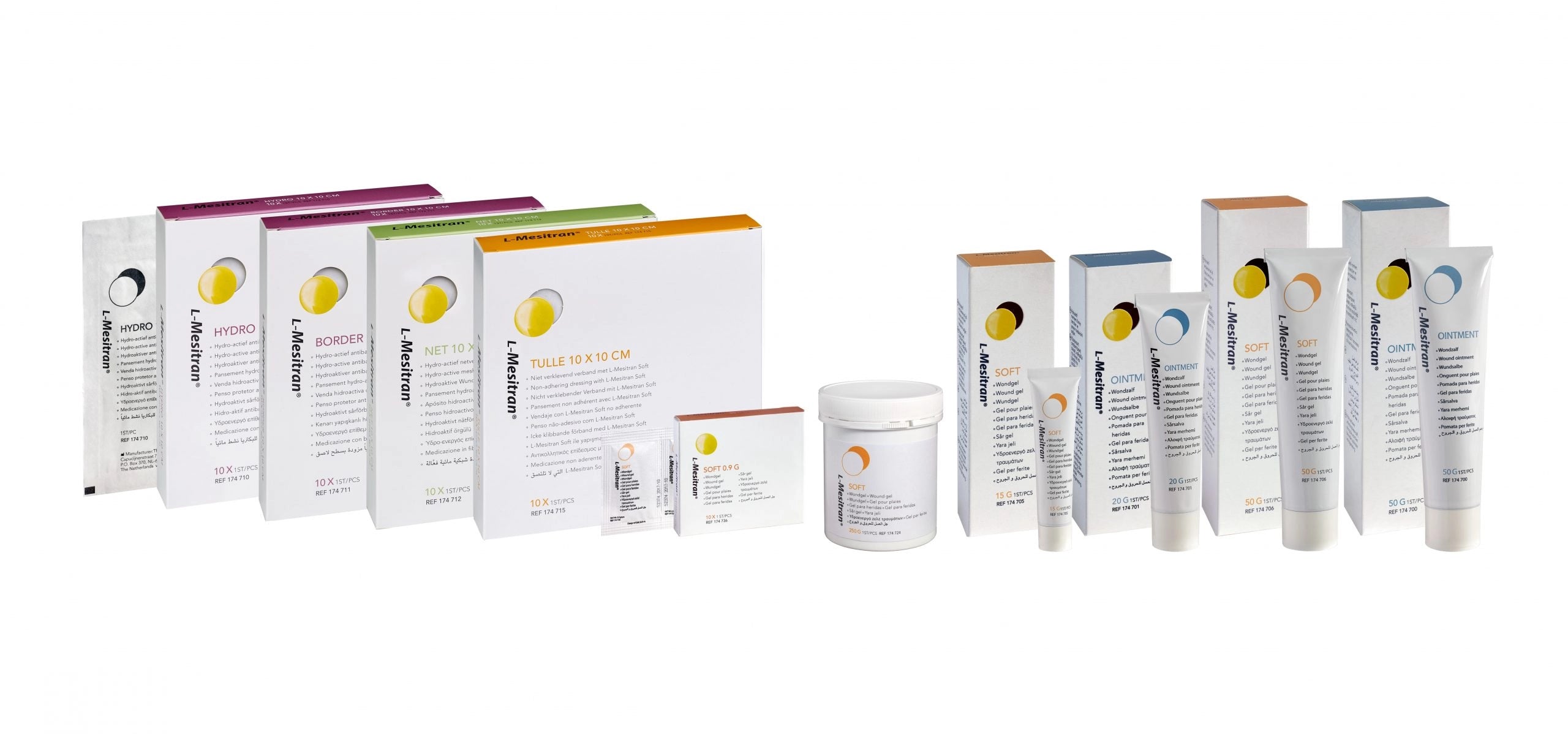
L-Mesitran Product Portfolio
Explore the full range of L-Mesitran Medical Grade Honey wound care products.
L-Mesitran Soft (Wound Gel)
Hydro-active gel with ~40% Medical Grade Honey, enriched with vitamins C & E and lanolin; suitable for acute and chronic wounds.
Learn more →L-Mesitran Ointment
Antibacterial ointment with ~48% Medical Grade Honey; maintains a moist wound environment and supports autolytic debridement.
Learn more →L-Mesitran Foam
Non-adherent polyurethane foam impregnated with L-Mesitran Soft; cushions, absorbs, and retains exudate.
Learn more →L-Mesitran Tulle
Non-adherent mesh/tulle dressing coated with L-Mesitran Soft; conforms to irregular wound geometries.
Learn more →L-Mesitran Border
Self-adhesive hydro-active dressing containing ~30% Medical Grade Honey; easy fixation for superficial wounds.
Learn more →L-Mesitran Hydro
Hydro-active antibacterial sheet containing L-Mesitran Soft; ideal for wounds with low to moderate exudate.
Learn more →L-Mesitran Active
Small hydro-active dressing with ~30% Medical Grade Honey; adheres where regular dressings won’t stay (e.g., blisters or joints).
Learn more →
Clinical & Application Highlights
L-Mesitran products support all phases of wound healing, from debridement/cleansing to epithelialization and remodeling.
They are effective against biofilms and local infections, even against some antibiotic-resistant organisms.
The dressings create a moist wound environment via osmotic activity, support autolysis of necrotic tissues, and enhance cell migration.
Dressings are designed for ease of use, minimal pain on removal, and less frequent changing (depending on wound exudate level).
L‑Mesitran Wound Care Protocol
Guidance matrix (no images) showing recommended L‑Mesitran dressings by wound bed appearance and exudate level. Always follow local clinical protocols.
| Wound type | Dry | Moderate exudate | Heavy exudate | |||
|---|---|---|---|---|---|---|
| Superficial | Deep | Superficial | Deep | Superficial | Deep | |
| Red wound protect · moist env · bacterial balance · stimulate epithelization |
TulleSoftHydroBorder |
Soft |
TulleSoftHydroBorderFoam |
SoftFoam |
SoftNetFoam |
SoftFoam |
| Yellow wound debride · remove bacteria · moist env · stimulate healing |
TulleSoftHydroBorder |
Soft |
TulleSoftHydroBorderFoam |
SoftFoam |
SoftNetFoam |
SoftFoam |
| Black wound cleanse · remove necrosis · reduce bacteria |
TulleSoftOintment |
OintmentSoft |
TulleOintmentFoam |
OintmentFoam |
OintmentNetFoam |
OintmentSoft |
| Post‑operative wound improve healing · reduce scarring · prevent infection |
TulleOintment |
Soft |
TulleOintment |
Soft |
TulleSoft |
Ointment |
This chart is a simplified, image‑free representation for web display. Product choices may vary with assessment, location, and protocol. Consider patient comfort, exudate levels, and dressing change frequency when selecting between Soft, Ointment, Tulle/Net, Hydro, Border, and Foam.
L-Mesitran: The Clinician's Guide to Medical Grade Honey Wound Care
L-Mesitran is a range of licensed medical grade honey dressings used to manage acute and chronic wounds, and it works differently from any honey found on a supermarket shelf. For wound care nurses, podiatrists, and surgeons across South Africa, the question is rarely whether honey has a place in modern wound care. It does. The real question is which format suits a given wound bed, what the evidence actually shows, and how to source the full range reliably.
This guide answers those questions in one place. It covers how medical grade honey works, the seven L-Mesitran formats available locally, a wound bed selection matrix, the clinical evidence behind the range, and honest limits every clinician should know before applying it.
Need the full range for a facility or tender? Request a bulk quote (we respond within 24 hours) or speak to a clinical advisor.
What Is L-Mesitran and How Does Medical Grade Honey Work?
L-Mesitran is a CE-marked medical device built around medical grade honey, not food-grade honey. That distinction matters clinically and legally.
Medical grade honey is produced under controlled conditions and sterilised by gamma irradiation. This step removes the risk of Clostridium botulinum spores and other contaminants that can be present in raw honey, while leaving the honey's antimicrobial properties intact. Which means a clinician can apply it directly to an open wound with confidence.
Supermarket honey is a food product. It is not sterilised, its composition is not standardised, and it carries no regulatory approval for wound use. Applying it to a wound risks introducing bacterial spores into compromised tissue.
L-Mesitran also enriches its honey base with supportive ingredients such as vitamins C and E, zinc oxide, and medical-grade lanolin, depending on the format. These support the wound environment rather than acting as drugs.
Explore the full advanced wound care range to see where honey-based dressings fit alongside other modalities.
The Mechanism of Action: Antimicrobial, Debriding, and Anti-Inflammatory Effects
L-Mesitran acts through several physical mechanisms at once, which is why bacteria do not develop resistance to it the way they do to antibiotics.
- Osmotic effect: the high sugar concentration draws fluid out of bacterial cells and out of the wound, supporting autolytic debridement of slough and necrotic tissue.
- Low pH: honey acidifies the wound surface, creating conditions that inhibit bacterial growth and support healing.
- Hydrogen peroxide generation: glucose oxidase in the honey releases hydrogen peroxide slowly and at low, tissue-safe levels, providing sustained antimicrobial action.
Together these effects reduce bioburden, loosen devitalised tissue, and calm the inflammatory phase. The result is a moist wound environment that supports granulation.
The L-Mesitran Product Range: Choosing the Right Format for the Wound Bed
The L-Mesitran range spans seven formats, each with a different honey concentration, carrier, and exudate profile. Matching the format to the wound is what separates a good outcome from a stalled one.
| Format | Medical honey | Format type | Exudate suited to | Indicated wound type |
|---|---|---|---|---|
| Soft | 40% | Gel in a hydrogel base | Low to moderate | Superficial and cavity wounds, sensitive skin, mixed wound beds |
| Ointment | 48% | Viscous ointment | Dry to low | Dry wounds, peri-wound skin, superficial abrasions, burns |
| Foam | Impregnated | Foam dressing | Moderate to heavy | Exuding wounds needing absorption plus antimicrobial cover |
| Tulle | 100% honey coat | Knitted contact layer | Low to moderate | Skin tears, donor sites, superficial wounds needing a non-adherent layer |
| Border | Impregnated | Self-adhesive island dressing | Low to moderate | Superficial wounds where an all-in-one bordered dressing is preferred |
| Hydro | Impregnated | Hydrocolloid/hydrogel dressing | Low | Dry to lightly exuding wounds, granulating beds needing moisture retention |
| Active | High-strength formulation | Gel with reinforced antimicrobial support | Low to moderate | Stalled, colonised, or hard-to-heal chronic wounds |
Scroll the table sideways to see all columns.
Browse the antimicrobial wound dressings category for the complete specification of each format.
L-Mesitran Soft: The Versatile Honey Wound Gel for Moist Wound Healing
L-Mesitran Soft is the most widely used format and the usual starting point for clinicians new to the range. It contains 40% medical grade honey in a supplemented hydrogel, which means it delivers antimicrobial action while adding moisture to drier beds.
Soft suits superficial and cavity wounds, mixed red and yellow wound beds, and fragile or sensitive skin. It spreads easily and rinses out cleanly at dressing changes. See the L-Mesitran Soft wound gel for full details.
L-Mesitran Ointment: For Dry, Superficial, and Peri-Wound Skin
L-Mesitran Ointment carries a higher honey concentration at 48% in a lanolin-based ointment. It is designed for dry and lightly exuding wounds, superficial burns, and the protection of vulnerable peri-wound skin.
Because it is occlusive, it holds moisture against a dry bed without macerating surrounding tissue. Review the L-Mesitran Ointment product page for indications and application notes.
Clinical Indications: Which Wounds Respond Best to L-Mesitran
L-Mesitran is indicated across a wide spectrum of acute and chronic wounds, but it performs best on colonised, sloughy, or stalled wounds where bioburden is holding back healing.
Common indications include:
- Chronic wounds: venous leg ulcers, arterial ulcers, pressure injuries, and diabetic foot ulcers.
- Acute wounds: surgical wounds, traumatic wounds, skin tears, and abrasions.
- Burns: superficial and partial-thickness burns.
- Colonised and malodorous wounds: where honey's antimicrobial and deodorising action helps.
The format follows the wound. A dry, superficial pressure injury calls for Ointment or Hydro, while a moderately exuding sloughy ulcer calls for Soft or Foam. Use the matrix below to match the wound bed and exudate level to the right format. This guidance is for clinicians assessing wounds: it does not replace individual patient assessment.
| Wound bed | Dry / minimal exudate | Moderate exudate | Heavy exudate |
|---|---|---|---|
| Red (granulating) | Ointment, Hydro | Soft, Border | Foam |
| Yellow (sloughy) | Soft (adds moisture) | Soft, Active | Foam |
| Black (necrotic) | Soft or Ointment (rehydrate for autolysis) | Soft, Active | Foam + Active |
| Post-operative (superficial) | Ointment, Border | Border, Soft | Foam |
| Post-operative (deep/cavity) | Soft (loosely pack) | Soft + Foam | Foam |
Scroll the table sideways to see all columns.
For a foam option in exuding wounds, see the L-Mesitran Foam dressing, and for a non-adherent contact layer, the L-Mesitran Tulle.
Application Technique and Dressing Change Protocol
Correct application decides whether L-Mesitran delivers its full effect. The technique is simple, but a few steps are easy to get wrong.
- Cleanse the wound. Irrigate with saline or purified water and gently remove loose debris.
- Apply the honey generously. For Soft and Ointment, apply a layer roughly 3 mm to 5 mm thick across the wound bed. A thin smear is not enough to sustain the osmotic gradient.
- Fill cavities loosely. Pack Soft into cavities without tension: over-packing raises pressure on the wound bed.
- Cover with a secondary dressing. Match absorbency to exudate: a low-adherent pad for light exudate, a foam or absorbent pad for heavier exudate.
- Secure and date the dressing.
Dressing change frequency depends on exudate and honey depletion. Honey is diluted by wound fluid over time, so heavily exuding wounds may need daily changes, while dry, low-exudate wounds can hold a dressing for up to seven days.
A practical tip from clinical use: if the secondary dressing sticks or the patient reports tightness, moisten it with purified water before removal. This reduces trauma and discomfort.
For bordered convenience, the L-Mesitran Border combines the honey layer and fixation in one dressing.
Integrating L-Mesitran Into Your Wound Care Protocol
L-Mesitran fits neatly into a structured wound care protocol, and the strongest evidence supports its use as an antimicrobial and debriding option.
A University of Ghent laboratory study, published in the journal Antibiotics (MDPI), tested medical grade honey products against wound biofilms. L-Mesitran Soft demonstrated stronger anti-biofilm activity than several comparator medical grade honey products in that in-vitro model. That is what the study found: it is not a claim that the product is superior in every clinical setting.
A separate clinical evaluation of L-Mesitran Foam, indexed on PubMed Central (PMC), reported positive outcomes in exuding wounds, supporting its role where absorption and antimicrobial cover are both needed.
When adding L-Mesitran to a protocol, clinicians typically position it at the antimicrobial or debridement step of the wound-bed-preparation pathway, alongside sharp or autolytic debridement. It pairs with compression in venous ulcer management and with offloading in diabetic foot care.
For moisture-retentive granulating beds, the L-Mesitran Hydro supports the healing phase. Read more about medical grade honey in wound care for the wider clinical context.
Safety, Contraindications, and Patient Considerations
L-Mesitran has a strong safety record, but honest limits matter. Clinicians should know what to expect and where the product is not appropriate.
Transient pain is the most common consideration. The osmotic action of the sugars and the drop in wound pH can cause a stinging or drawing sensation on application, particularly on sensitive or neuropathic-adjacent tissue. This usually subsides within an hour. Moistening the secondary dressing with purified water reduces it, and persistent pain warrants review.
Contraindications and cautions:
- Known hypersensitivity to any ingredient, including honey, lanolin, or bee-derived components.
- Caution in patients with a diagnosed allergy to bee products.
- An initial increase in exudate is normal as the osmotic effect draws fluid: select an adequately absorbent secondary dressing rather than abandoning the product.
L-Mesitran is safe to use across most patient groups when applied by a competent clinician. It does not sting the way an antiseptic solution does, and diabetic patients can use it, as the sugar is not absorbed systemically through intact wound management.
When in doubt, patch-test or trial on a small area first. That five-minute step can prevent an avoidable adverse reaction.
This information is intended as a general guide. Always consult a registered healthcare professional for diagnosis and treatment of any medical condition.
L-Mesitran in South Africa: SAHPRA Status, Distribution, and Ordering
Dynamed is the exclusive South African distributor of L-Mesitran. That means one accountable source of supply for the entire range, not a partial listing.
For procurement officers, this section covers the essentials.
- Regulatory standing: L-Mesitran is supplied in line with South African medical device requirements and SAHPRA regulations, with Dynamed handling regulatory and documentation matters as the responsible distributor.
- Full-range availability: all seven formats, from Soft to Active, are held in stock rather than sourced ad hoc.
- Nationwide delivery: dispatch runs from warehouses in Durban and Johannesburg, reaching public and private facilities across the country.
- Clinical training and protocol support: the Dynamed clinical team provides in-service training, format selection guidance, and protocol integration support. A reseller can list a product: only the distributor can support its correct use.
- Bulk and tender supply: structured pricing for hospitals, groups, and government tenders, with single-source-of-supply assurance.
No prices are published here because facility, volume, and tender terms differ. For hospital-scale needs, see the full range of hospital wound care supplies.
Ready to order or trial the range? Request a bulk quote (we respond within 24 hours), or speak to a clinical advisor about training and protocol support.
L-Mesitran Frequently Asked Questions
What is L-Mesitran?
L-Mesitran is the pioneering brand of wound care products based on medical grade honey. We aspire to deliver high quality products for fast and efficient wound healing.
The first product, L-Mesitran Ointment, has been approved in Europe since 2002. The products are CE approved for the European market, FDA approved for the market in the USA and further they are approved in over fifty countries worldwide with differentiated registrations. The products are used in hospitals, nursery homes, domestic care and of course the consumer at home. All of the products are provided with a leaflet including specific instructions for use for each product alone.
Why can’t I just buy honey in the supermarket and apply it straight onto the wound?
There are a number of reasons why you should not apply supermarket honey on wounds:
– Honey from the supermarket is not indicated or licensed to be used as a medical device.
– Honey frequently contains a bacteria (clostridium botulinum) which causes wound botulism and can be fatal.
– Honey can contain all sorts of pollutants that are not dangerous when digested by healthy human beings, but are unwanted in a wound. For example, heavy metals, pesticides and herbicides.
Not all types of honey are the same and can vary in their therapeutic effect.
Our products are licensed medical devices for wound management. The production and selection of the honey is done by qualified persons and the production processes are validated and audited by medical device authorities (CE and FDA).
You can be sure L-Mesitran is safe and effective to use.
What is the origin of the honey used in your products?
The honey we use is certified organic honey, harvested conform strict guidelines. For example, the honey has to be free from antibiotics and may not contain herbicide or pesticides, heavy metals or other pollutants. We use several floral species and the honey is tested to meet our medical grade standard. Furthermore, the honey is irradiated by gamma radiation to make sure all pollutants, that might cause an adverse reaction, are killed.
Can L-Mesitran cause pain?
In some cases, L-Mesitran can cause pain. It has been reported to cause pain when using L-Mesitran Ointment and sometimes L-Mesitran Soft. The pain can be caused due to the osmotic action of the sugars in the honey and the change of pH in the wound bed when applying the products.
The pain usually subsides after a short while. When this is not the case, you should consult with a physician and perhaps use a painkiller. Another method is to wet the gauze covering the wound with purified water. This will diminish the osmotic action and can provide relieve.
What is L-Mesitran used for?
L-Mesitran is used to manage acute and chronic wounds, including leg ulcers, pressure injuries, diabetic foot ulcers, burns, surgical wounds, and skin tears. Its medical grade honey provides antimicrobial action, supports autolytic debridement, and maintains a moist environment that helps wounds progress toward healing.
Is L-Mesitran an antibiotic?
No. L-Mesitran is not an antibiotic. It is a medical device with antimicrobial action delivered through physical mechanisms: an osmotic effect from its sugars, a low pH, and slow hydrogen peroxide generation. Because these are physical rather than drug-based, bacteria do not develop resistance to it.
What are the ingredients in L-Mesitran Soft?
L-Mesitran Soft contains 40% medical grade honey in a supplemented hydrogel base. It also includes supportive ingredients such as vitamins C and E and other components that maintain the wound environment. The honey is sterilised by gamma irradiation, making it safe for direct wound application.
How does L-Mesitran work?
L-Mesitran works through three combined actions. The high sugar concentration draws fluid osmotically, loosening slough. The low pH inhibits bacterial growth. And glucose oxidase releases low-level hydrogen peroxide for sustained antimicrobial cover. Together these reduce bioburden and support granulation in a moist environment.
How often should L-Mesitran dressings be changed?
Dressing change frequency depends on exudate levels. Heavily exuding wounds may require daily changes as wound fluid dilutes the honey, while dry, low-exudate wounds can retain a dressing for up to seven days. Change when honey is depleted or the secondary dressing becomes saturated.
Why does the surrounding tissue of the wound turn reddish after the L-Mesitran is applied?
L-Mesitran activates the wound healing process. Within this natural process, an inflammatory phase is inevitable. This phase is crucial in order to cleanse the wound of dead tissue and microorganisms. This inflammatory phase is characterized by the fact that the blood vessels surrounding the wound supply more blood to the wound area.
Where can I buy L-Mesitran products?
Find your distributor here
What is L-Mesitran and how does medical grade honey work differently from regular honey?
L-Mesitran is a CE-marked medical device using medical grade honey sterilised by gamma irradiation, removing harmful spores while preserving antimicrobial properties. Unlike supermarket honey, it's produced under controlled conditions and regulatory-approved for wound use. Supermarket honey carries contamination risks and lacks standardisation for clinical application.
How does L-Mesitran wound dressing treat wounds?
L-Mesitran works through three mechanisms: osmotic action draws fluid from bacteria and wounds, supporting debridement; low pH inhibits bacterial growth; and glucose oxidase releases low-level hydrogen peroxide for sustained antimicrobial cover. These physical actions prevent bacterial resistance, making it effective on colonised, sloughy, or stalled wounds.
Which L-Mesitran format should I use for heavily exuding wounds?
L-Mesitran Foam is the recommended format for moderate to heavy exudate, providing absorption plus antimicrobial cover. For stalled or colonised wounds with heavy exudate, combining Foam with Active offers reinforced antimicrobial support. Format selection depends on wound bed type and exudate level.
Can diabetic patients safely use L-Mesitran honey dressings?
Yes. L-Mesitran is safe for diabetic patients because the sugar in the dressing is not absorbed systemically through intact wound management. The honey's antimicrobial and debriding properties make it particularly useful for diabetic foot ulcers when applied by a competent clinician.
What should I do if L-Mesitran causes stinging or pain on application?
Transient stinging is normal, caused by osmotic action and pH change, typically subsiding within an hour. Moisten the secondary dressing with purified water before application to reduce discomfort. If pain persists, clinical review is warranted to rule out adverse reactions or alternative dressing selection.